Industry
Cookie consent for online shops
Your storefront, your checkout and three ad platforms all follow the same choice. Velo sets the consent signals your shop’s tags read, in every region you sell to.

Examples on this page use sample data. This is not legal advice.
Works with the platforms you build on












From product page to purchase
An online shop on Shopify runs Google Analytics 4, Google Ads and the Meta Pixel. Here’s what its tags do at each step of an order, for three different shoppers.
Illustrative example with sample data, not a customer story.
| Step | Shopper accepted | Shopper rejected | United States, GPC on |
|---|---|---|---|
| view_item | Measured | Cookieless | Analytics only |
| add_to_cart | Measured | Cookieless | Analytics only |
| purchase | Measured | Cookieless | Analytics only |
| Meta Pixel events | Sent | Not sent | Not sent |
| Shopify Customer Privacy API | Told the choice | Told the choice | Told the choice |
Cookieless means Google tags in advanced Consent Mode send pings without cookies. Google may model part of the gap in eligible accounts.
Every sale is measured by a tag that needs consent
A shop’s revenue reports, ad bidding and remarketing all run on tags that set cookies. In opt in regions those tags have to wait for a yes, and the purchase event has to carry the answer the shopper gave.
What goes wrong
- Ad pixels fire on the product page before the shopper has chosen.
- The purchase event reaches Google without a consent state.
- The checkout sits on a subdomain and asks for consent a second time.
What Velo does
- Sets Consent Mode v2 before your tags run and updates it on the shopper’s choice.
- Passes the choice to the Meta Pixel and Microsoft UET.
- On Shopify, sends the choice to the Customer Privacy API.
- Shares one choice across your subdomains.
Two shoppers in two different regions
Here’s the same shop seen from Germany and from California.
Illustrative example with sample data, not a customer story.
A shopper in Germany
Until she chooses, Google tags send cookieless pings and the Meta Pixel is told consent is revoked. She accepts on the product page, so add to cart and purchase are measured in full.
A shopper in California with Global Privacy Control
The United States is opt out, so analytics runs. But his browser sends Global Privacy Control, so Velo turns advertising off without him having to ask and records the decision as a GPC refusal.
Check the purchase event
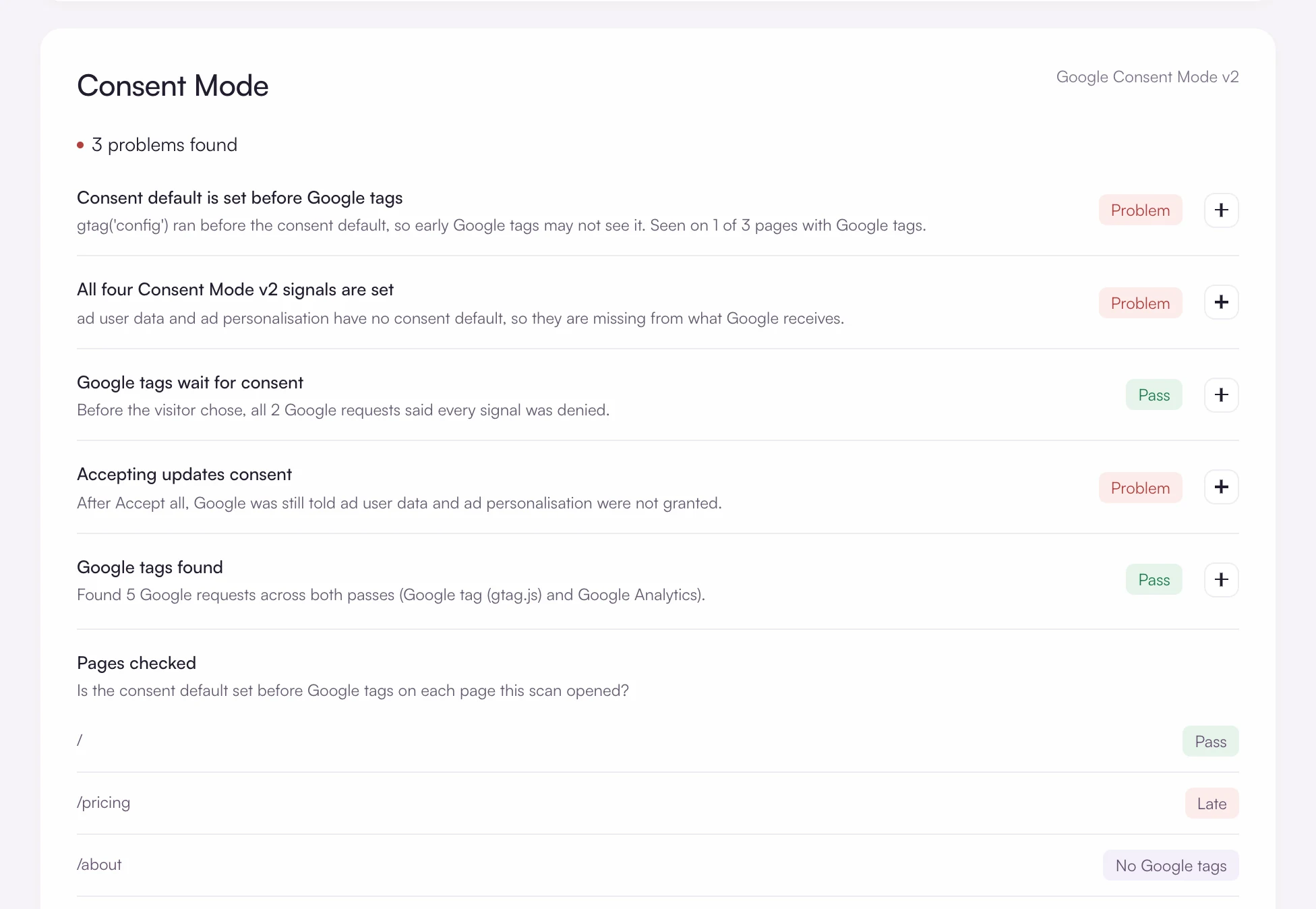
The scanner tests whether the consent default is set before Google tags run on the pages it visits. Then place a test order once after accepting and once after rejecting, with ?velo_debug=1 in the address, and compare what your tags send.
Answer a privacy request
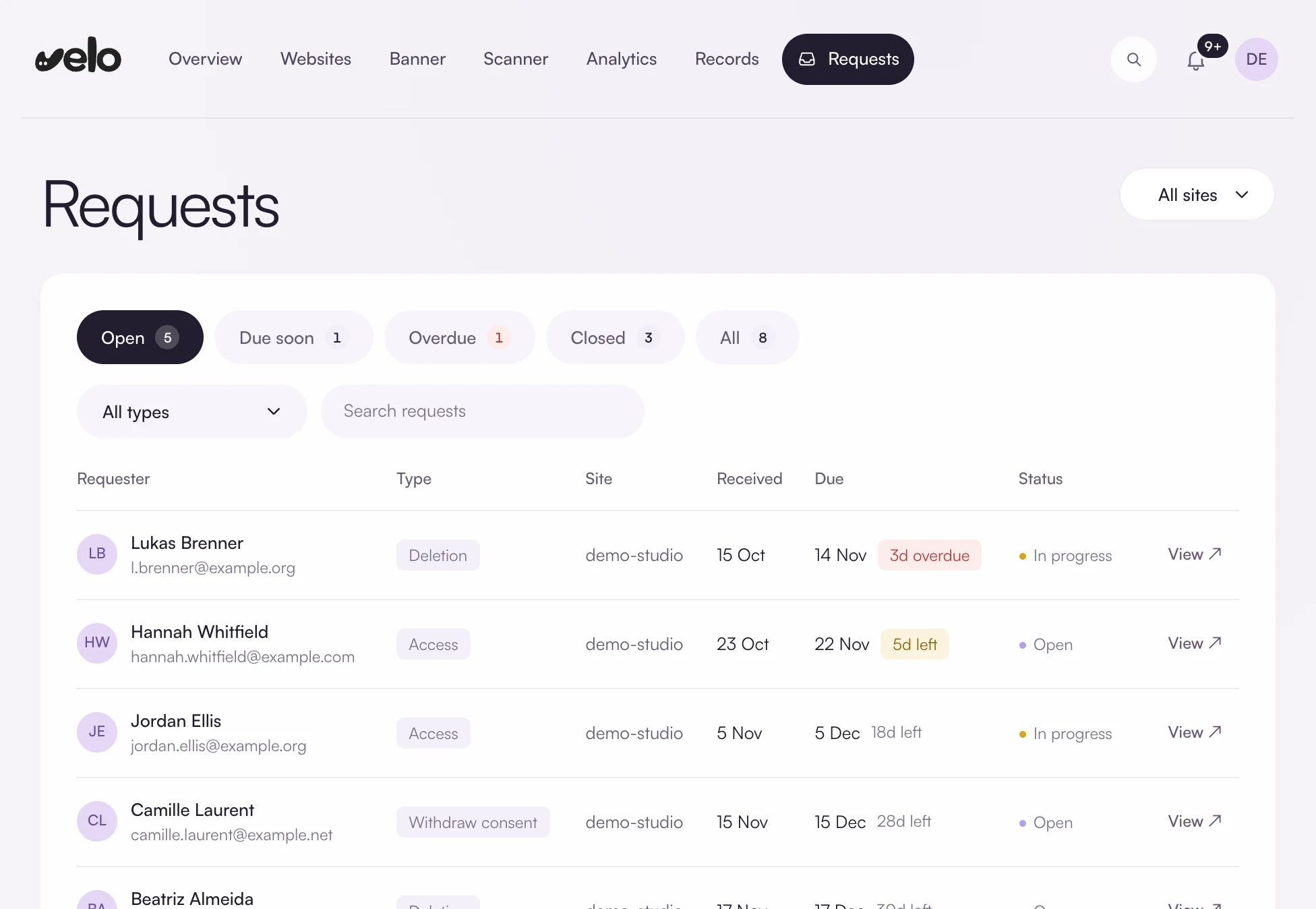
Deletion and access requests from the hosted form, or from your own, land in one queue, and each shows a reply by date 30 days out.
What Velo covers, and what it does not
The limits, stated plainly, so you can decide before you install anything.
Questions and answers
Does Velo work with Shopify’s own privacy settings?
Yes. Velo passes each choice to Shopify’s Customer Privacy API, which is where Shopify’s pixels and the apps that use it look for consent.
Will consent change my conversion numbers?
Yes, where shoppers say no. Velo makes sure the answer reaches your tags correctly, so you only lose what was refused, not extra data through late or missing signals. Google may model part of the gap in eligible accounts.
Does Velo make my website compliant?
No tool can promise that. Velo gives you a banner with a real choice, regional defaults, consent signals for your tags and a record of each decision. Whether your whole setup meets the law depends on what your site does with data, which is for you and your advisers to assess.
Free for one site
Banner, scan and consent records for one site, free. Pro from €7 a month, plus VAT, for unlimited sites.