Industry
Cookie consent for travel and hospitality
Guests arrive from many countries and often book on more than one domain. Velo shows each guest the default their law expects, in their language, and tells you plainly where a booking engine breaks the chain.
Examples on this page use sample data. This is not legal advice.
A guest in Munich, a guest in New York and a guest in São Paulo open the same page. Each meets the default their law expects, in their own language.
A hotel with guests from three countries
A hotel’s site runs Google Analytics 4, Google Ads and the Meta Pixel. Rooms are booked on a booking engine at another domain.
Illustrative example with sample data, not a customer story.
Three guests, each with their own default
The guest in Munich and the guest in São Paulo choose before any optional tag runs, each in their own language. The guest in New York gets the opt out default, with Reject on the first layer.
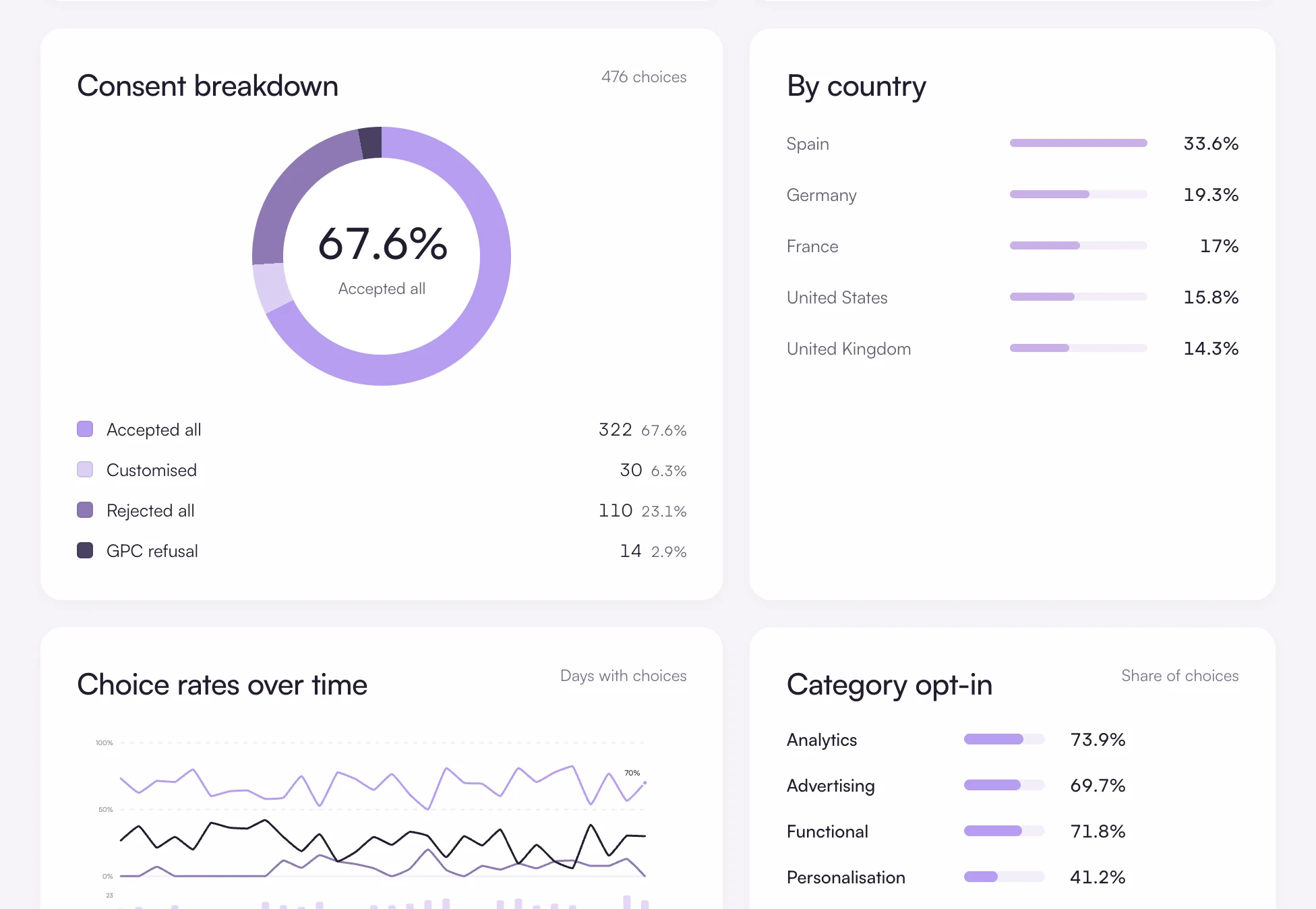
Country by country, in your analytics
The consent breakdown shows how visitors answered, by country and by category, so you can see where guests accept and where they do not.
The booking path
Where the guest’s choice follows them, and where it stops.
- hotel.example
The guest chooses once
On your own domain the choice is stored and sent to your tags on every page.
- book.hotel.example
The choice goes with them
A booking page on a subdomain of your domain reads the same choice, so the guest isn’t asked again.
- bookingengine.example
This is where the choice stops
A booking engine on another domain does not see the choice. If it lets you add scripts, install Velo there as a second site. If it does not, Velo cannot run there.
International guests and third party booking engines
A hotel or tour operator’s visitors come from wherever its guests live. Many bookings finish on a booking engine hosted on another company’s domain, which is exactly where advertising needs to see the conversion.
What goes wrong
- One default and one language for guests from every country.
- The booking engine on another domain shows its own banner, or none.
- The booking reaches the ad platform without a consent state.
What Velo does
- Applies opt in or opt out from each visitor’s country.
- Shows the banner in the guest’s browser language, from 14 languages.
- Sets Consent Mode v2 for Google tags and passes the choice to the Meta Pixel and Microsoft UET.
- Shares one choice across your subdomains.
Check the default in each region
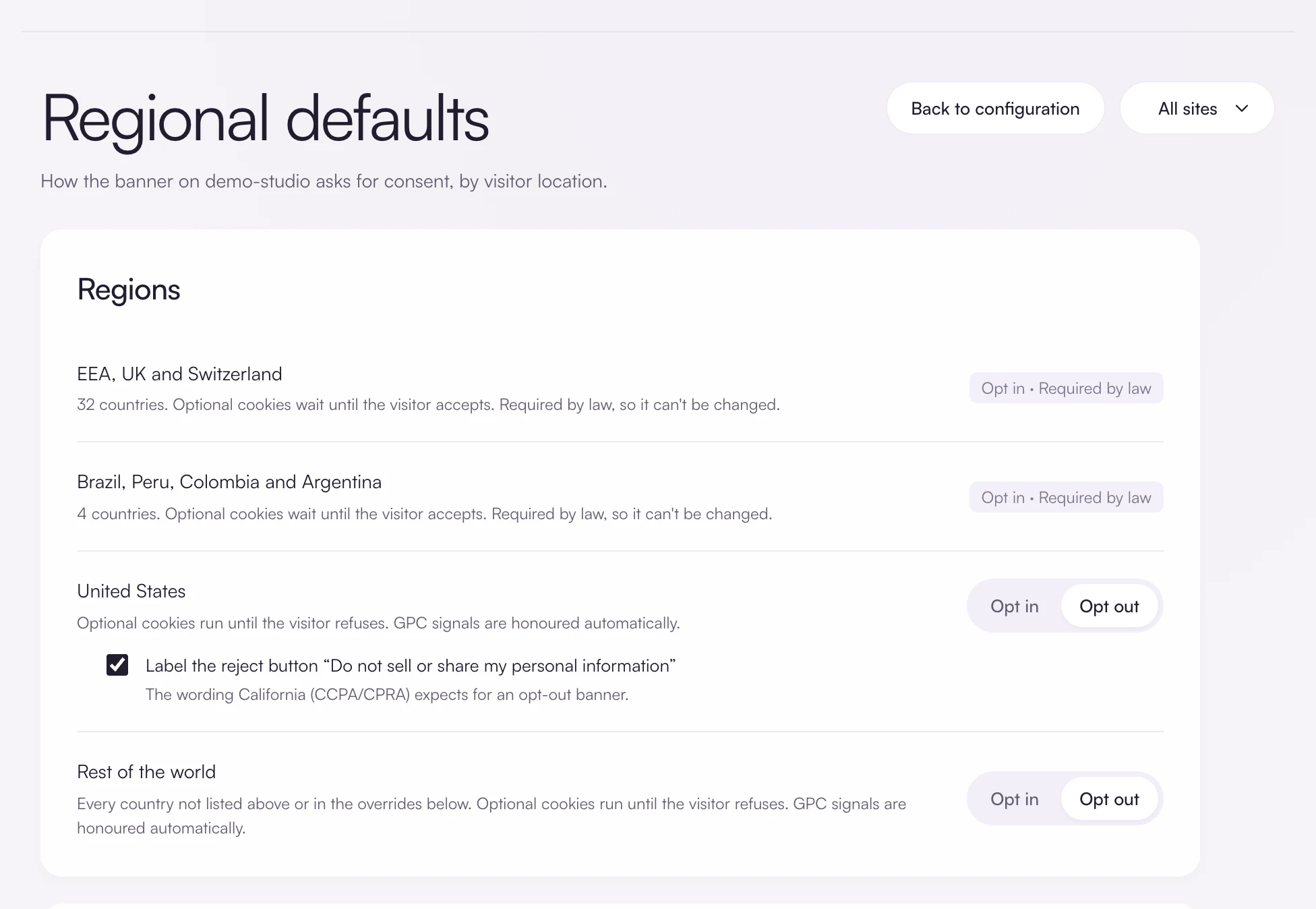
Opt in is locked across the EEA, the UK, Switzerland, Brazil, Peru, Colombia and Argentina. For the United States and the rest of the world the default is opt out, and you can switch either to opt in.
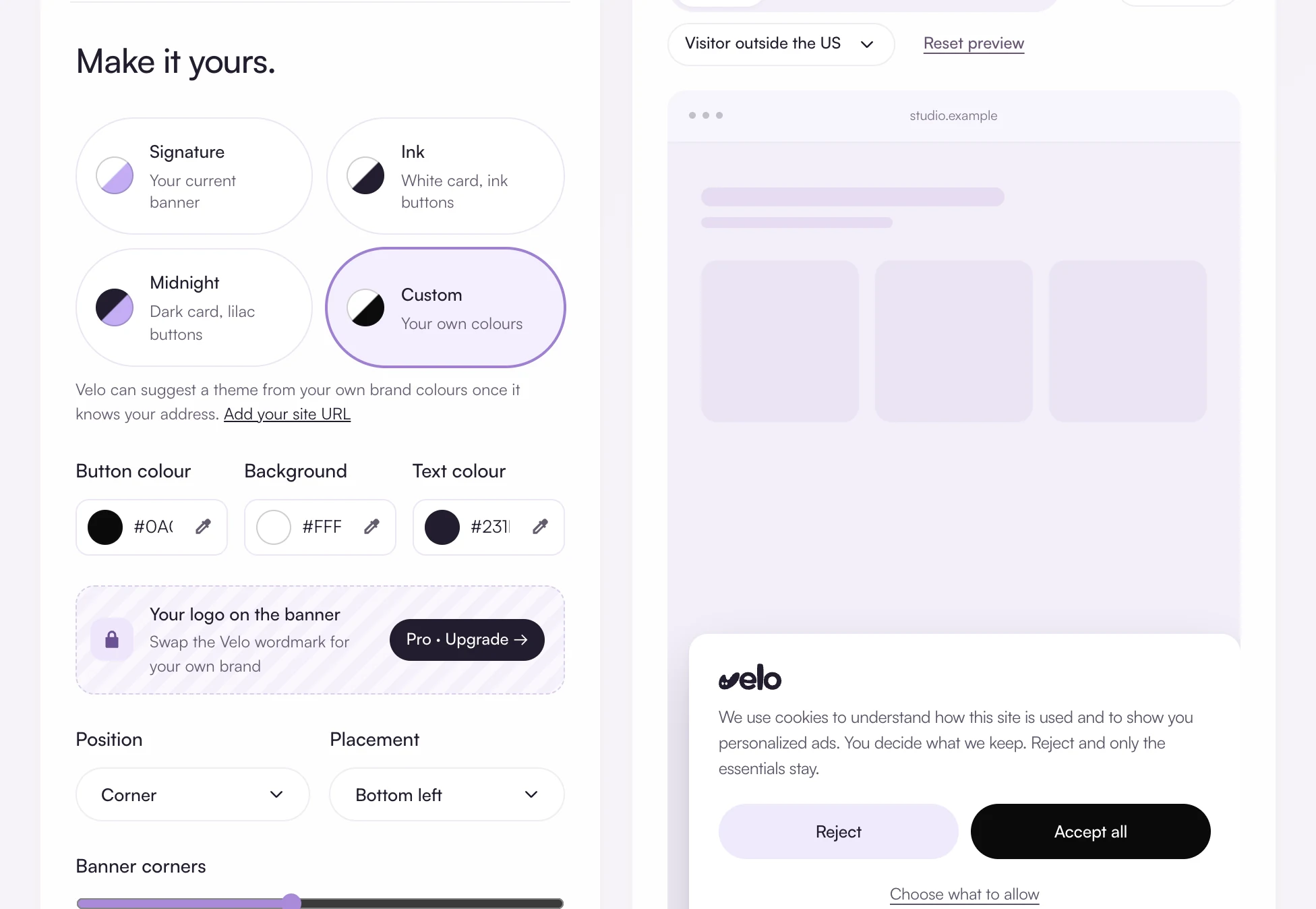
Write the banner once per language
Enable the languages your guests read and edit the wording for each. Velo picks one from the guest’s browser.
What Velo covers, and what it does not
The limits, stated plainly, so you can decide before you install anything.
Questions and answers
Can consent carry over to my booking engine?
Only if the engine runs on a subdomain of your own domain. On a different domain the guest’s choice is not shared, and Velo has to be installed there as its own site.
Which languages does the banner speak?
English, Spanish, Catalan, German, French, Italian, Dutch, Portuguese, Polish, Estonian, Swedish, Danish, Finnish and Czech. Velo picks from the guest’s browser language among the ones you have enabled.
Does Velo make my website compliant?
No tool can promise that. Velo gives you a banner with a real choice, regional defaults, consent signals for your tags and a record of each decision. Whether your whole setup meets the law depends on what your site does with data, which is for you and your advisers to assess.
Free for one site
Banner, scan and consent records for one site, free. Pro from €7 a month, plus VAT, for unlimited sites.