Industry
Cookie consent for education
Admissions pages, course catalogues and open day forms that measure enquiries with consent. Velo has no age check, so sites for children need more than a banner.
Examples on this page use sample data. This is not legal advice.
Recruitment runs on the same tags as any campaign
Universities, schools and course providers advertise for enquiries and applications like any other organisation, often to international audiences and sometimes to people under 18. The public site needs the right default for each country, and tags that wait for it.
What goes wrong
- Recruitment pixels run before a prospective student has chosen.
- International visitors get one default, whatever their country.
- Departments add scripts nobody has categorised.
What Velo does
- Applies opt in or opt out from each visitor’s country.
- Sets Consent Mode v2 for Google tags and passes the choice to the Meta Pixel and Microsoft UET.
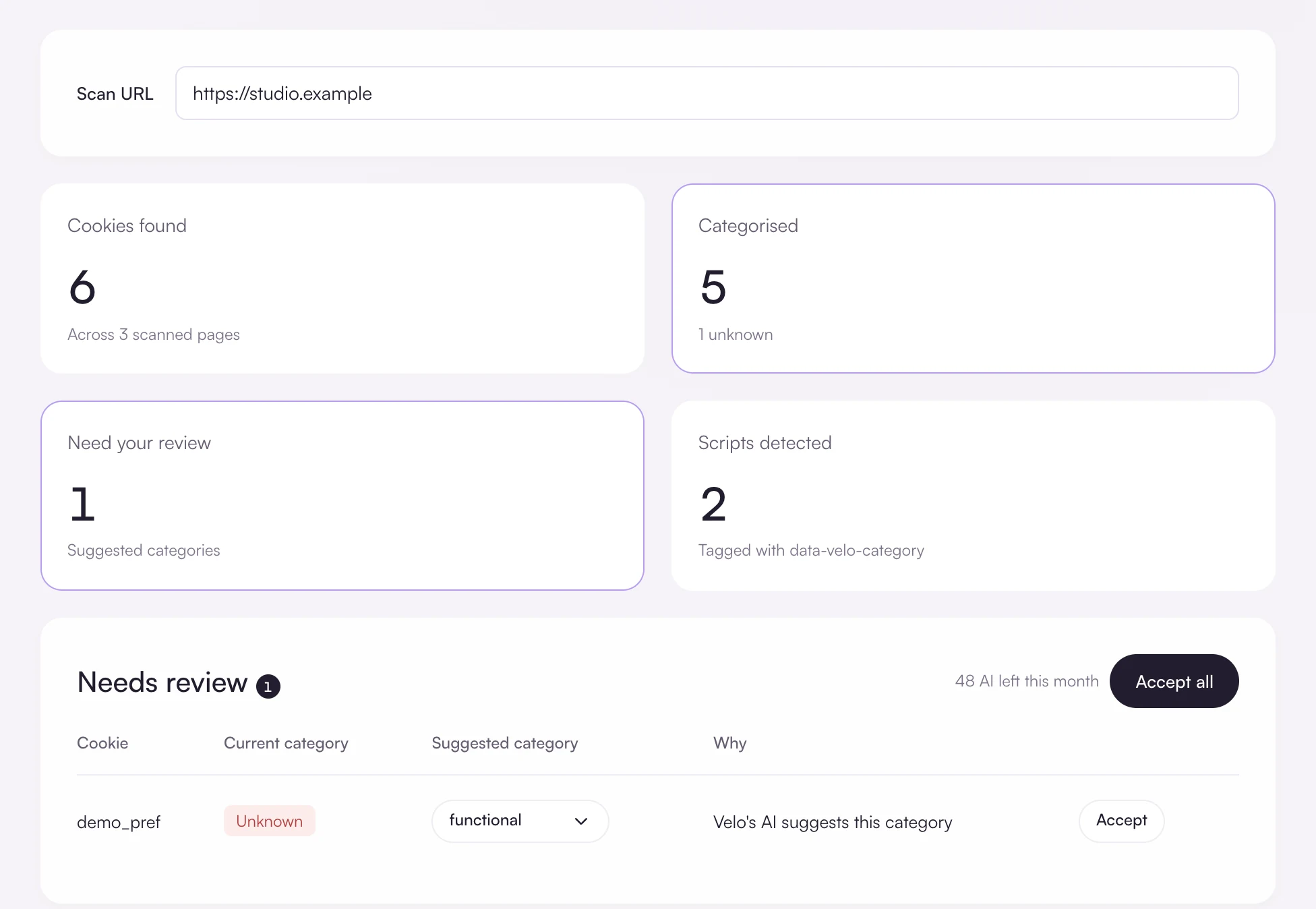
- Scans your pages and lists the cookies it finds, with a category for each.
- On Pro, rescans every month so new cookies show up.
Who adds what to a university site
On a large site no single team knows every tag. Here’s where each kind usually comes from, and how it shows up in Velo.
| Team | What they add | How it shows up in Velo |
|---|---|---|
| Marketing | Google Ads and the Meta Pixel for recruitment campaigns. | Consent Mode v2 and the Meta consent call, from the first page. |
| Admissions | Enquiry and open day forms, and a chat widget. | Once it’s marked functional, the chat script waits. |
| Departments | Survey tools and embedded video. | New cookies turn up in the next scan for you to review. |
| IT | Google Analytics and the tag manager. | The Velo CMP template runs first, on Consent Initialization. |
Illustrative example with sample data, not a customer story.
A university admissions site
A university’s admissions site runs Google Analytics 4, Google Ads and the Meta Pixel for an international recruitment campaign, with an open day booking form.
Illustrative example with sample data, not a customer story.
An applicant in France opens the form
Analytics and advertising signals are denied until she chooses, and the Meta Pixel is told consent is revoked. The booking form works either way.
A department adds a survey tool
The next monthly rescan on Pro finds a cookie nobody has categorised. It appears in the scanner, where it can come with a suggested category, and nothing changes on the banner until someone accepts it.
Review what the scan finds
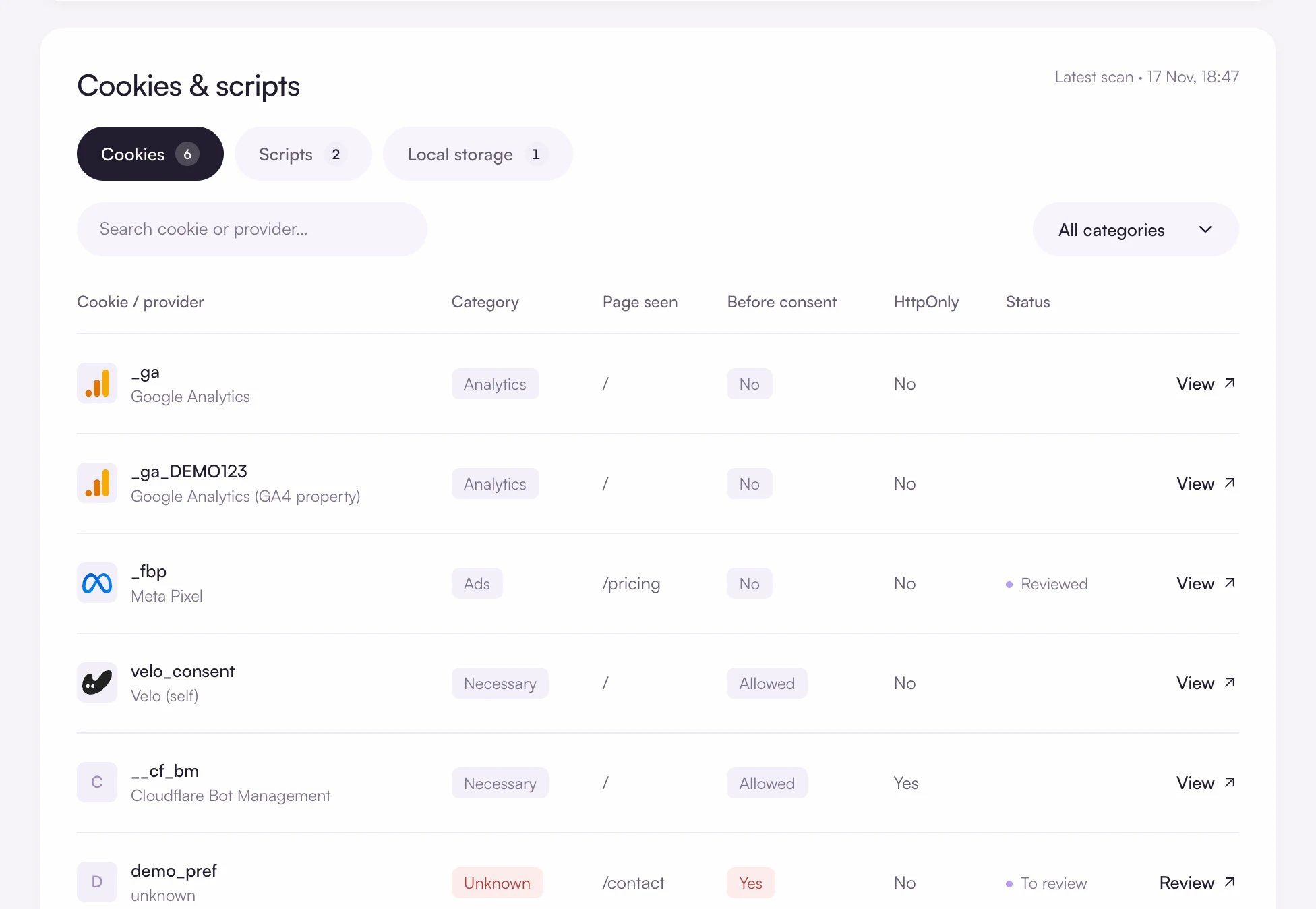
Each scan lists cookies with their provider, category and the page they were seen on. Unknown cookies wait for your review.
Check the default in each region
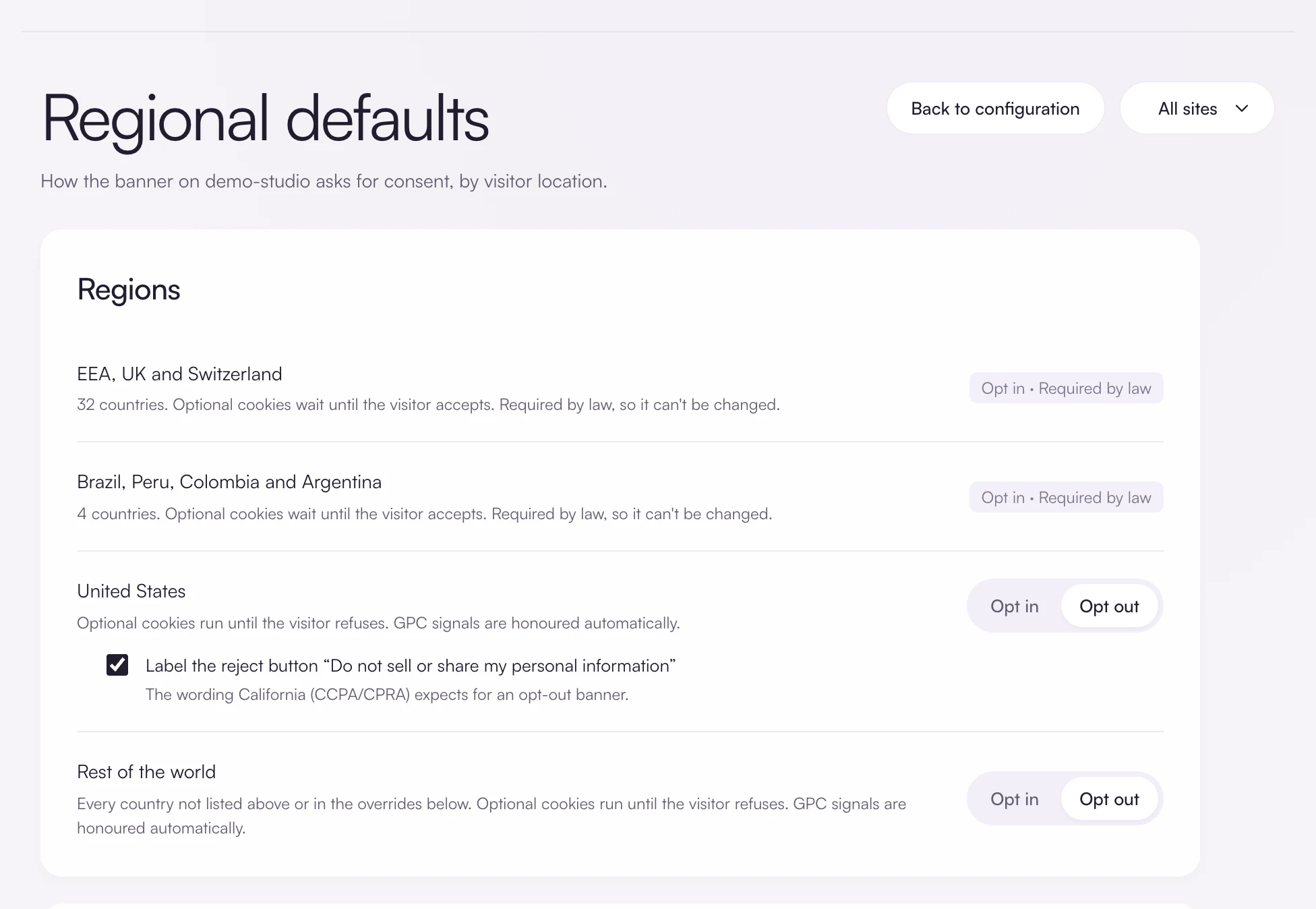
Opt in is locked across the EEA, the UK, Switzerland, Brazil, Peru, Colombia and Argentina. For the United States and the rest of the world the default is opt out, and you can switch either to opt in.
Answer a privacy request
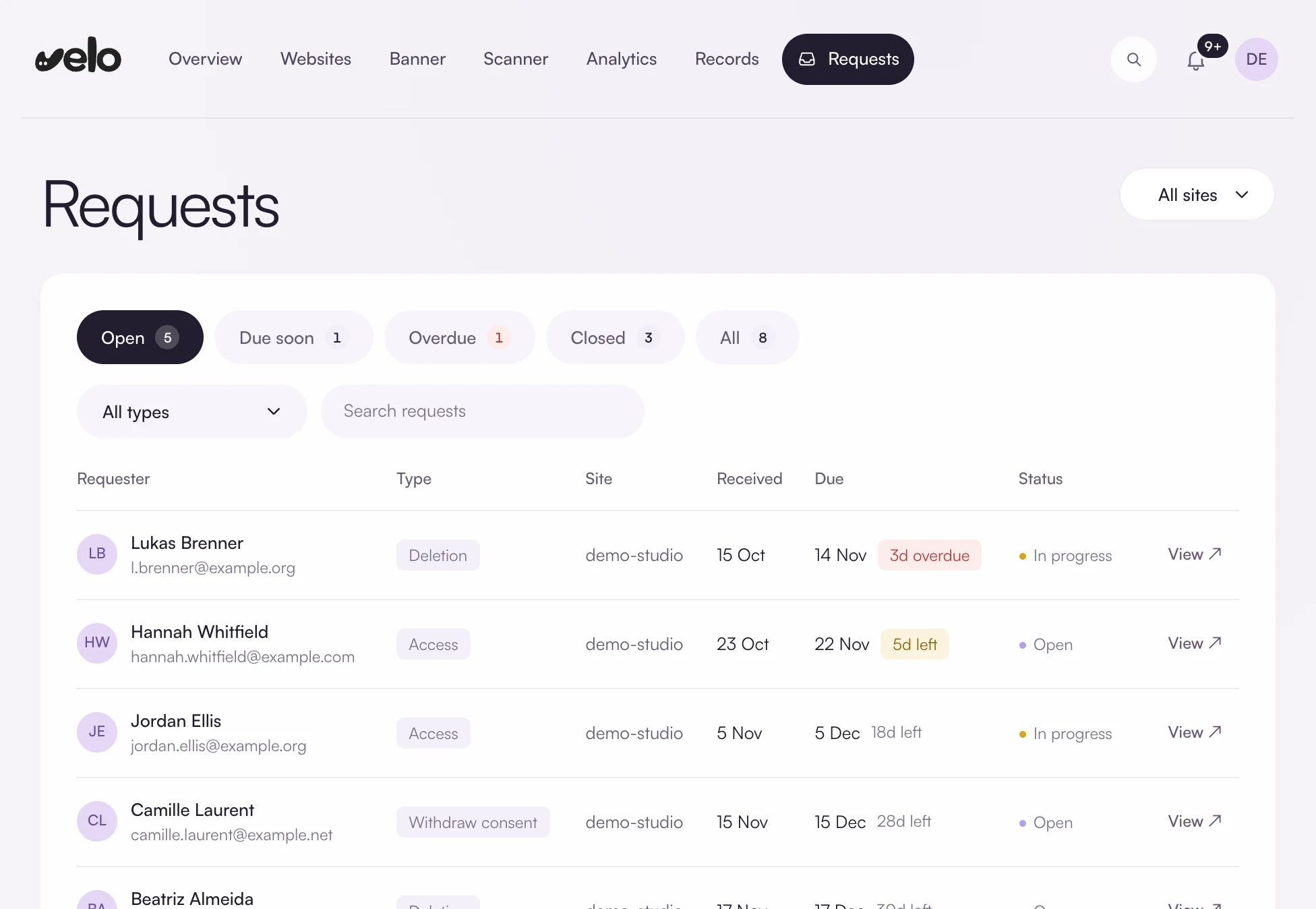
Deletion and access requests from the hosted form, or from your own, land in one queue, and each shows a reply by date 30 days out.
What Velo covers, and what it does not
The limits, stated plainly, so you can decide before you install anything.
Questions and answers
Can Velo ask for parental consent?
No. Velo has no age gate, age verification or parental consent flow. If your site is aimed at children, take advice on what applies before you run any tracking.
We have many faculty and campaign sites. How is that priced?
Pro covers unlimited sites, and sessions are counted across all of them in one allowance. Each site has its own banner, scans and records.
Does Velo make my website compliant?
No tool can promise that. Velo gives you a banner with a real choice, regional defaults, consent signals for your tags and a record of each decision. Whether your whole setup meets the law depends on what your site does with data, which is for you and your advisers to assess.
Free for one site
Banner, scan and consent records for one site, free. Pro from €7 a month, plus VAT, for unlimited sites.