Use case
Privacy requests answered on time
Access, deletion and consent withdrawal requests arrive in one queue. Each gets a reply by date 30 days after it arrived, a warning a week before and a flag when it is overdue.
Examples on this page use sample data. This is not legal advice.
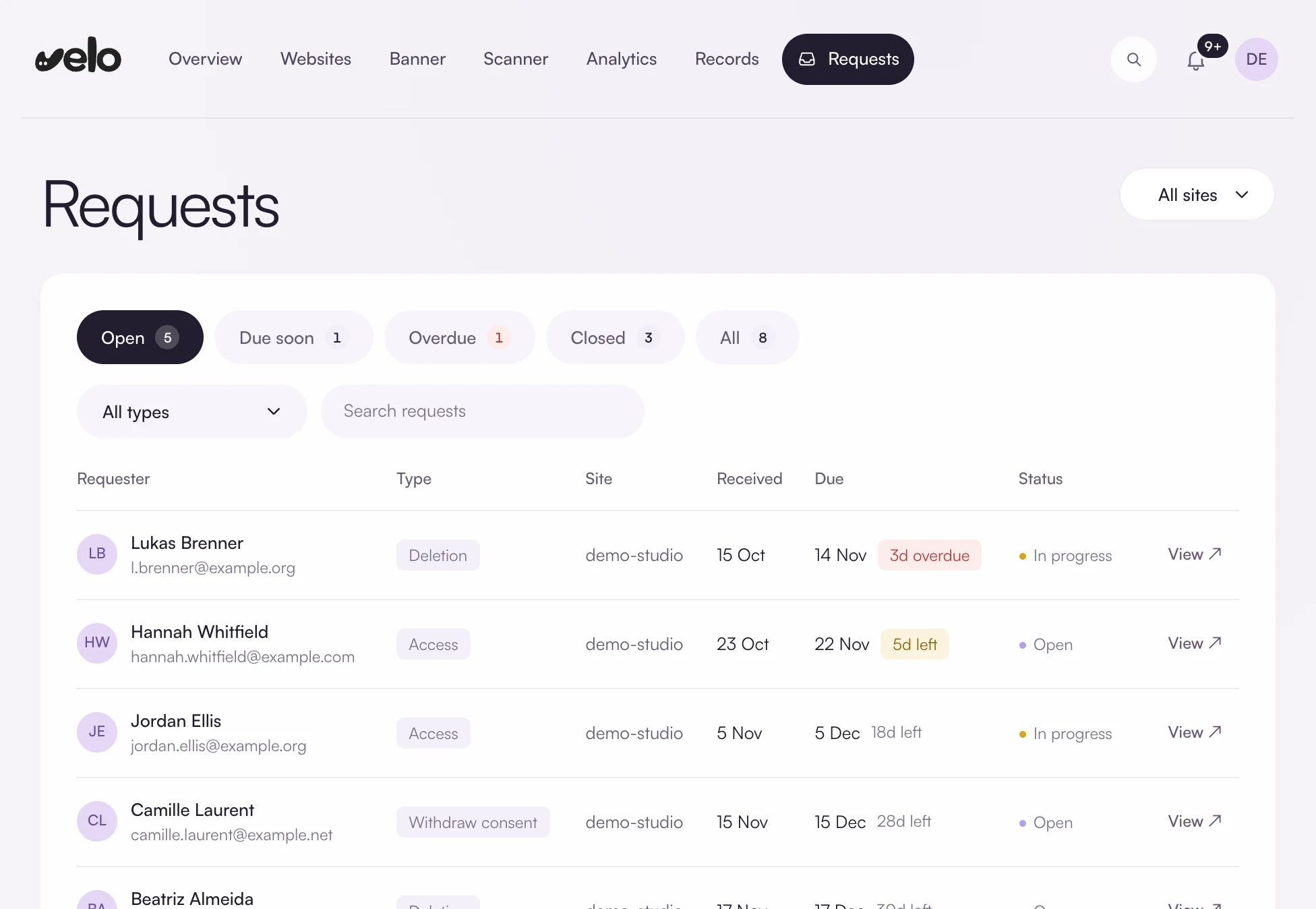
How the thirty days play out
This is what Velo does with a request between the day it arrives and the day a reply is due.
- Arrival
The request lands in the queue
It is listed as open with its reply by date, and you are notified in the console.
- 7 days before
Due soon
A week before the date the request moves to the due soon view, and you are notified again.
- 30 days after
Reply by
The date Velo sets for every request, counted from the day it arrived.
- After that
Overdue
A request still open after its date is flagged overdue until you resolve or reject it.
A deadline that starts when the request lands
Under the GDPR, a person who asks what you hold about them, or asks you to delete it, is owed an answer within one month. Requests tend to arrive in a shared inbox, get forwarded twice and surface again after the deadline.
What goes wrong
- Requests sit in an inbox nobody owns.
- Nobody knows which day a reply is due.
- The consent history a person asks about takes a day to find.
What Velo does
- Collects requests into one queue, from a form Velo hosts for your site or from your own.
- Sets a reply by date 30 days after each request arrives.
- Emails each requester a link to confirm the address is theirs.
- Notifies you in the console when a request arrives and a week before it is due.
- Shows the consent receipt and history a request refers to.
One deletion request, start to finish
A customer of an online shop asks for her data to be deleted. The dates are examples.
Illustrative example with sample data, not a customer story.
Day 1: the request arrives
She fills in the form on the shop’s privacy page. The request appears in the queue as open, with a reply by date of 2 April, and the account owner gets a notification.
Days 6 to 9: the work, and the reply
The shop’s team opens the request, sees her consent history beside it and exports it. They delete her account in the shop system and her profile in the email tool themselves, reply to her, and mark the request resolved.
Velo keeps the queue, the dates and the consent history. Finding and deleting the data in your other systems, and writing the reply, stay with you.
You hear about it in the console
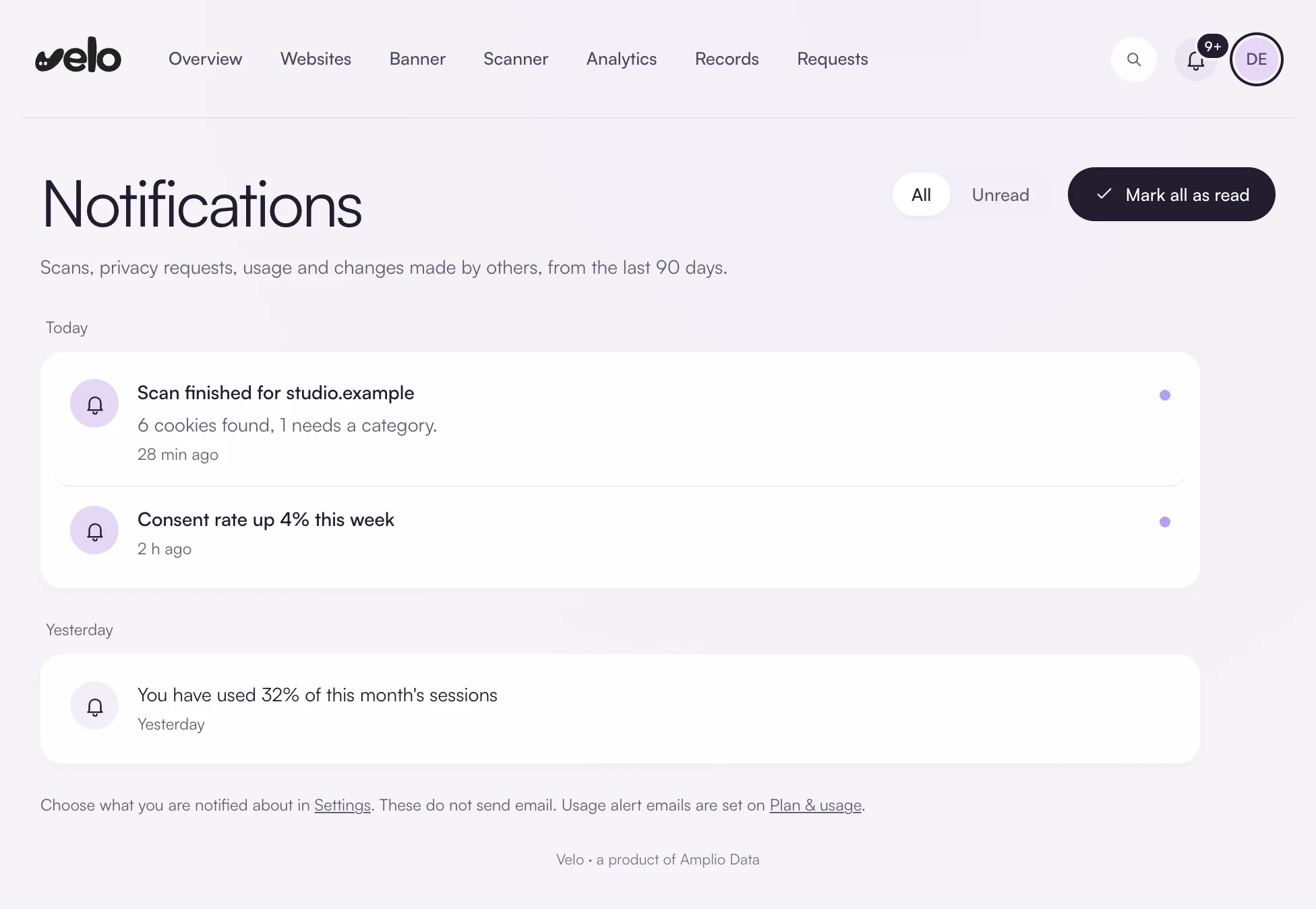
A notification appears when a request arrives and when it is due soon. Request notifications are shown in the console and are not sent by email.
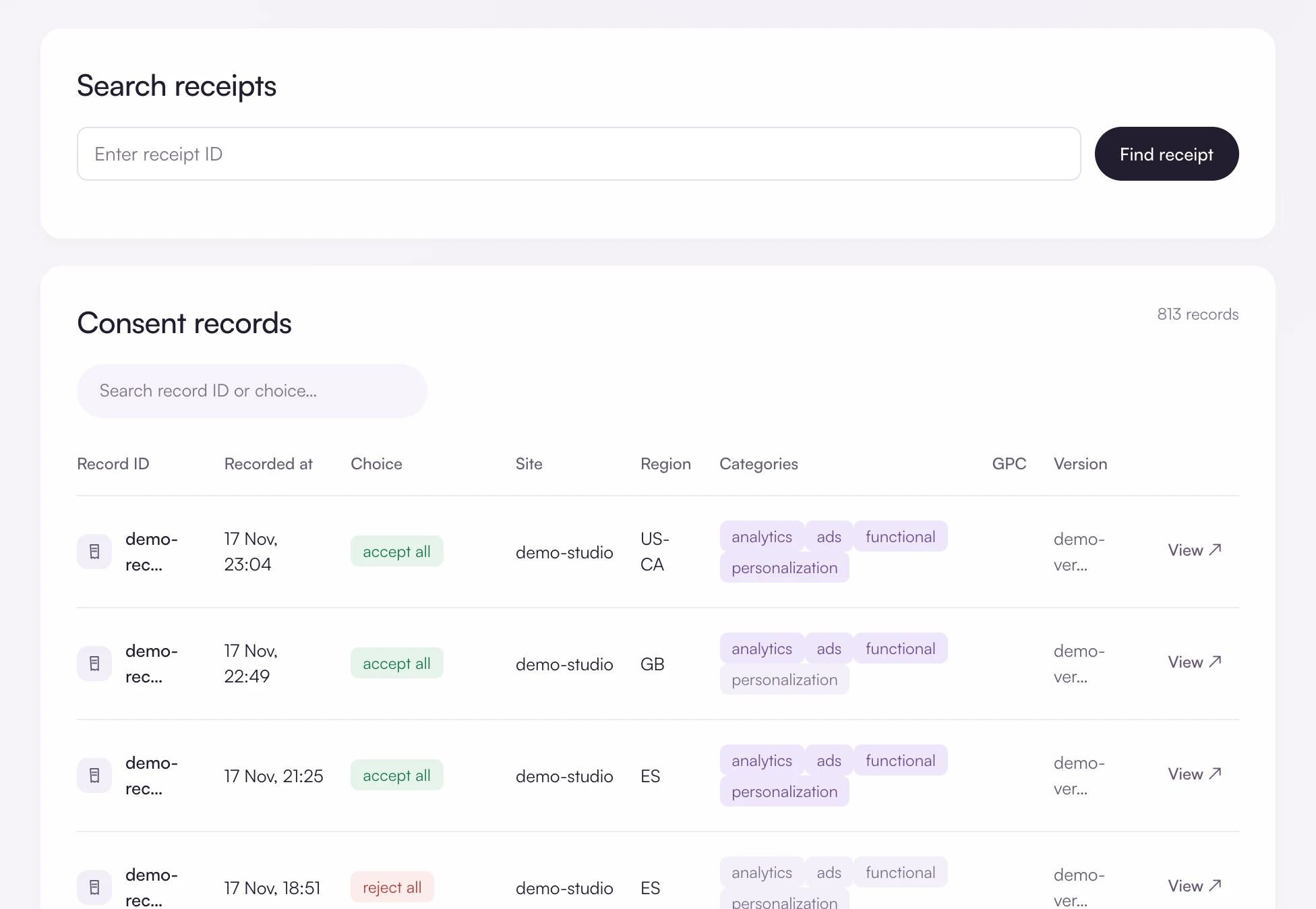
The consent history beside the request
When a request carries a receipt ID, Velo shows that receipt and the visitor’s earlier decisions, and exports them as CSV for your reply.
What Velo covers, and what it does not
The limits, stated plainly, so you can decide before you install anything.
Questions and answers
Does Velo answer the request for me?
No. Velo keeps the queue, the dates and the consent history. Finding, exporting or deleting the person’s data in your other systems, and writing the reply, stay with you.
How do visitors send a request?
Through the form Velo hosts for your site, linked from your privacy notice, or a form you build that posts to Velo. Either way the person gets an email to confirm their address.
Is 30 days the legal deadline?
It is a working date, not legal advice. The GDPR gives one month, which can be extended in some cases, and other laws set other limits. Velo applies 30 days to every request so that none is left undated.
Free for one site
Banner, scan and consent records for one site, free. Pro from €7 a month, plus VAT, for unlimited sites.